

Agents of change
Saturday, August 14, 2010

Friday, August 6, 2010
Zoom out, Zoom in
As my review panel had advised, I decided to take a step back and see what the 'larger than life' picture is. Systems thinking and design is something Rustam had also told me to look at. Wikipedia defines systems thinking as the process of understanding how things influence one another within a whole. In nature, systems thinking examples include ecosystems in which various elements such as air, water, movement, plants, and animals work together to survive or perish. In organizations, systems consist of people, structures, and processes that work together to make an organization healthy or unhealthy.
Systems thinking has been defined as an approach to problem solving, by viewing "problems" as parts of an overall system, rather than reacting to specific part, outcomes or events and potentially contributing to further development of unintended consequences. Systems thinking is not one thing but a set of habits or practices within a framework that is based on the belief that the component parts of a system can best be understood in the context of relationships with each other and with other systems, rather than in isolation. Systems thinking focuses on cyclical rather than linear cause and effect.
Here are some examples of different kinds of system maps.


So, I need to understand the whole system before I can do anything to it.
I read up on this and tried to draw an information flow diagram. An information flow is an illustration of information flow throughout an organisation or system. An IFD shows the relationship between external and internal information flows. It also shows the relationship between the internal and sub-systems. I tried putting in all the factors within this scenario that influence each other. My panel had told me, "If you had all the time, money and resources, what would you do with this project? What are all the possibilities? Put them all down." So, I tried doing just that. Once I did that, I don't know how much clearer it was in my head because it looked like this!

One thing that I could do though, is zoom in. From all these possibilities, I knew what I wanted to work on exactly. This zone was what I wanted to handle. Of course, all of them are linked to each other, as seen in the map.While zooming in, I was told to look at where in this system can I leverage the right amount of time, effort and energy so that it produces a positive feedback loop. Sometimes, even though the intent it right, what we do might produce negative feedback loops, which is just making an already complex system worse. So, I have to step back from time to time and see if I am creating positive feedback loops.

Yes, I am made this on Illustrator so that it is more understandable for everyone :) Here it is
Concept MapFrom this, the area I want to concentrate on is
So, I have make/facilitate or design something that involves children and makes them aware of the seriousness of fluoride in water and how rain water is a possible solution. Doing this in an interactive and fun way might lead to behavioural change. The next chart shows a few ideas on how I could possibly do this.
Monday, August 2, 2010
Nudges for action
Aim: To create little nudges from the associations obtained in the previous exercises through a playful mode.
Activity: The students can make little ‘mascots’ or ‘emoticons’; characters that they derive from their association with water. (Insights from the previous exercise might feed into it). They can use scrap material, clay, play dough, cut up pieces of paper, found objects, beads and buttons, M-seal etc. to create their mascot. After they have made their mascot, they can tie it up to their personal ‘squirter’ a device made from a plastic bottle that squirts out enough water to wash ones hands or water a plant. Soap strips or a small piece of soap could also be tied to this. They can carry this around with them during school hours or lunch hours to constantly remind them about this association they have. This might also be useful for them to wash their hands with soap near the plants when they go to their open loos or wash their plate etc. with minimal amount of water. If it is a small bottle, only the amount you squeeze comes out. This can later be refilled and used again.
Inference: Through this exercise, I hope the students are able to visualize their association and turn them into a ‘nudge’ that reminds them subtly at all times that they should be doing a particular thing; whether is washing their hand or throwing garbage into the bin or pouring enough water after they use the washroom (one topic that each student chooses).
Assumptions
> They would find it easy to make and use and carry it with them when they went to the loo
> Since they already knew their associations, they would find it easy to paint it onto their bottles.
> They would have a problem working with new material- like cutters and acrylic paints.


Reactions
This exercise changed drastically as I could not source enough and a variety of materials for them to make their mascots. I guess that was a constraint I had, since I had to carry all the material and travel by 4 buses to get there! Instead, I decided that they would make their squirter but would paint their associations on it instead of making a mascot that represented something. This device is something that these children can carry with them, anywhere they go, specifically to the open loos that they use. It makes hand-washing and easier and fun task for them to follow. The first day, I showed them what I had made, and a few of them who had bottles made their own. The next day, I told all of them to bring bottles that were thrown away at home to make their devices. I was really surprised when Soumya got this bottle to class to ask me if it was ok to use it. She had clearly understood what was needed and didn’t want to be messy with the hole. This bottle also had a cap to prevent leakage. I was really impressed.

They loved the soap strips most of all. The novelty of this itself might make them wash their hands for a week, but sadly they do not have access to paper soap in the village. Instead, I told them to cut up a piece of soap and tie it to their bottle, once the strips were over.


They quickly pierced their holes, tied up their threads and sat down to paint. This now, was a disaster. They just wanted to be done with it and get the soap, so that they could go and use it. However much I tried telling them to paint their links with water, most of them drew flowers and some even copied from the others! They were at peace only once they attached that soap. Chowdamma and Sushma wanted to show me how theirs worked! They even helped each other and worked together so that they could wash both their hands properly. Here is a video of that.

Sunday, August 1, 2010
Introducing them to Bio-Sand filters
Activity Four
Aim: An activity to show them a cause and effect action using water test vials and introduce them to the Bio-Sand filter
Activity: I could demonstrate to them how to make a bio-sand filter along with SODIS and tell them the importance of these two in conjunction. They can test the water they put in, before and after filtration using the H₂S bottle test. After that, they can make their own sand filters individually or in groups and keep them at school and use the water that comes from this filter.
Inference: Through this, the children might get to know that the water can be impure and there are methods by which they can take initiative to get clean water for themselves and their class/community.
Assumptions:
> Some of the water we rest is going to be bacteriology affected
> The students might be excited enough to make it and use the water from this filter
> They might go home and try to make it and share it with their family and friends
> Would ask me if they could test other water sources near their homes
Response
I showed them a video on how the sand filter works before they began, so that they would have an idea of how to go about making it. In groups of five, they made their filters, each competing to make theirs faster and better than the rest of the groups. They kept coming to me to 'check' if they were doing it right. It was the first time they were working with m-seal and cutting up material. They found it very exciting. Once their m-seal had dried, we went on to text the filters. One groups failed because their straw was cut at the wrong place and it started to leak, but four others worked right. They looked at it in awe when muddy water went through one end and clear water appeared through the other. One of them volunteered to come up and explain what she understood of the whole process. She was so enthusiastic that she even made diagrams of the filter in her book for herself to remember :) I was so happy there were students like this. The best moment was when they all came screaming saying "ma'am straw, ma'am gum" and I asked why they wanted these things? They replied saying they wanted to make one for themselves at home. They also tested the water that came out using the H2S strip test to find that is was not bacteriology contaminated. Some of them took bottles back home to test the water in the keres near their homes.


Sushma's notes on how the bio-sand filter works.
Inference
Introducing them to AT like this, something that they can make and see the effects for themselves was a good experience. They probably enjoyed it too. After the activity, when I asked someone to give me a summary, many of the kids were shy and some didn't know! So, if learning by just looking at it in textbook, none of them would have known. They said they had been studying about sand filters since 5th standard, but had never made one, even though it was so easy to make it.


Testing the filters they made
Sushma explaining to the class what they had done that day
Kilaralahalli
All this while, I thought that I lived and worked in the same village. Apparently not! Only this visit, did I realise that if something is just down the road, doesn't mean it is in the same village :) I stayed at C.K.Pura and the school is in Kilaralahalli. This was the first time I went by bus from C.K.Pura, hence I got to know.


Discovering the village
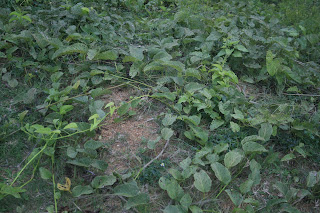
However liberated I fee in such environments, it is weird, for me and the people around, if I just walk in and out of their space. They have seen me around, but I never got a chance to interact with the people whose village I was living in. This visit was long enough for me to walk around in the evening and document the water bodies. Here is where I met my new friends who showed me around the village. I went to photograph the open well where all of C.K.Pura gets its drinking water from.




Here I met Mounica, Asha and Siri, three curious little girls who had come to take drinking water back to their homes after school was over. I went upto them and asked them if I could take a photo, in my broken Kannada. They obliged and asked me what I was doing there. After I told them, they decided to take me around the village, since it was play time anyway! Mounica graciously lent me her cycle (one that the government had provided her with to go to school) so that I could go for a spin as well!


I asked them about their school and home and what their parents did. Asha insisted that I go to her house and her mother gave me ground nuts that she had harvested. It was all very overwhelming! We walked on the bund and they showed me the 'kere' which practically had no water in it. It was a beautiful view though. They told me that we wouldn't be standing where we were if it were raining. The water would overflow till it reached the fields. This water was mostly used for agriculture. They even showed me the marked stone which showed them how much water there was left.
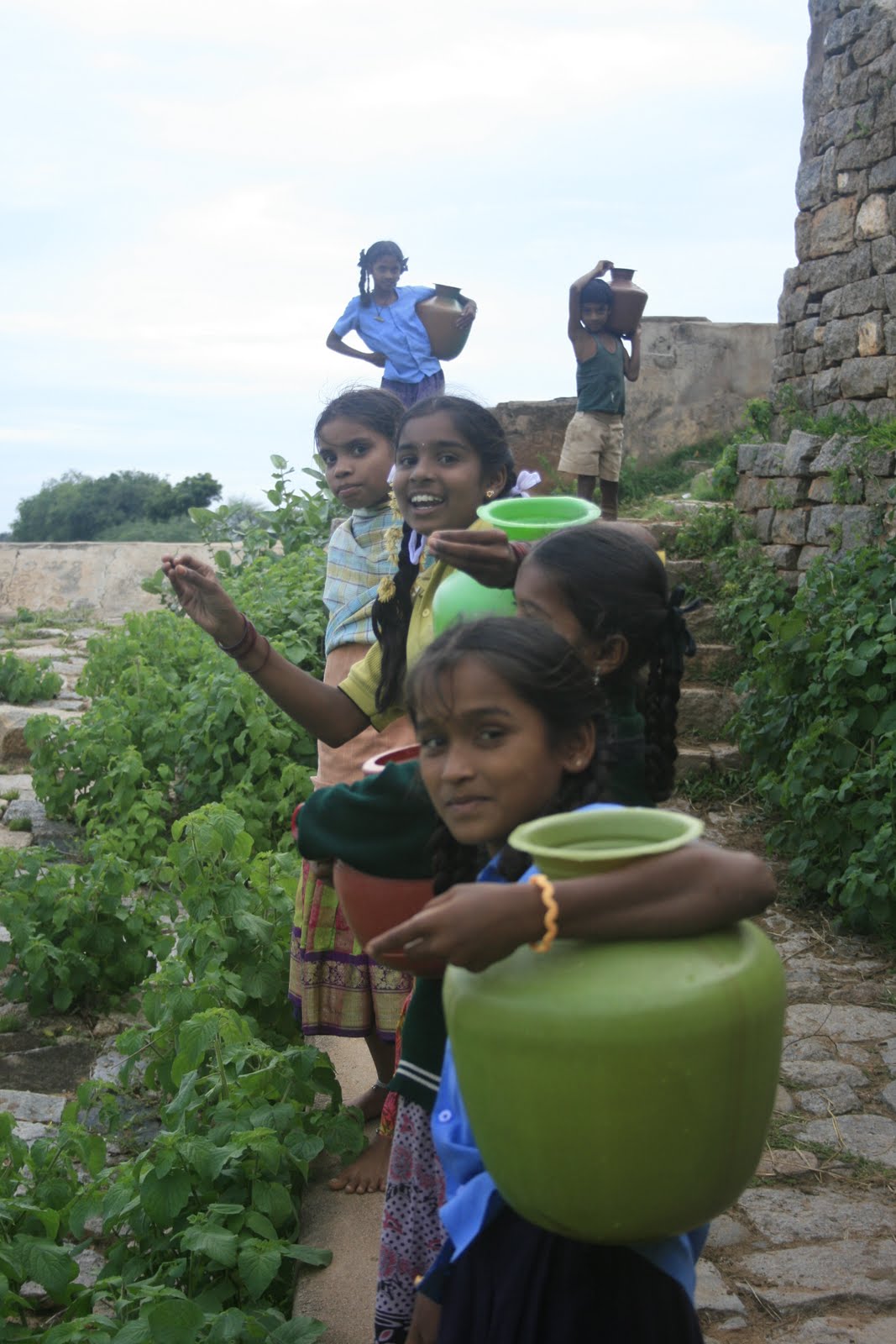


On the way, the showed me many plants and explained to me, what they do with it. They were not aware of the names of the plants, but they knew the uses.

"These are the thorns that they use to pierce their ears and noses in the village" said Asha, pointing to her nose.

"These flowers are squeezed. There is some liquid that comes out. The make soap out of that!" said an excited Akhila

Asha uses these long stemmed plants as her skipping rope, something she plays with everyday.
After this, we visited the Kalyani, a tank they have a bath in before they visit the temples and on festivals. They also swim in it occasionally. Akhila poured a few pots of water on the new cement slab they had built for a god's statue. The water from the Kalyani was pure and clean, she said.


Identifying problem areas
Initial activity idea
Activity: To trigger off initial thoughts, I could show them some slides or put up some charts with of what it takes to be clean and healthy. What are things one must do in order to use the available resources like water, not waste it, yet maintain personal and public hygiene?
The quick presentation I showed them to trigger off a discussion
I want to make flash cards that each have one icon related to health or hygiene. I will show them those cards and they can raise their hand to tell me how many of them actually follow those practices that are essential. Then, we can go around the campus and stick these cards in the places they belong in. (Hand washing with soap near their tank, boiling water before drinking near the pots they store water in, etc.)


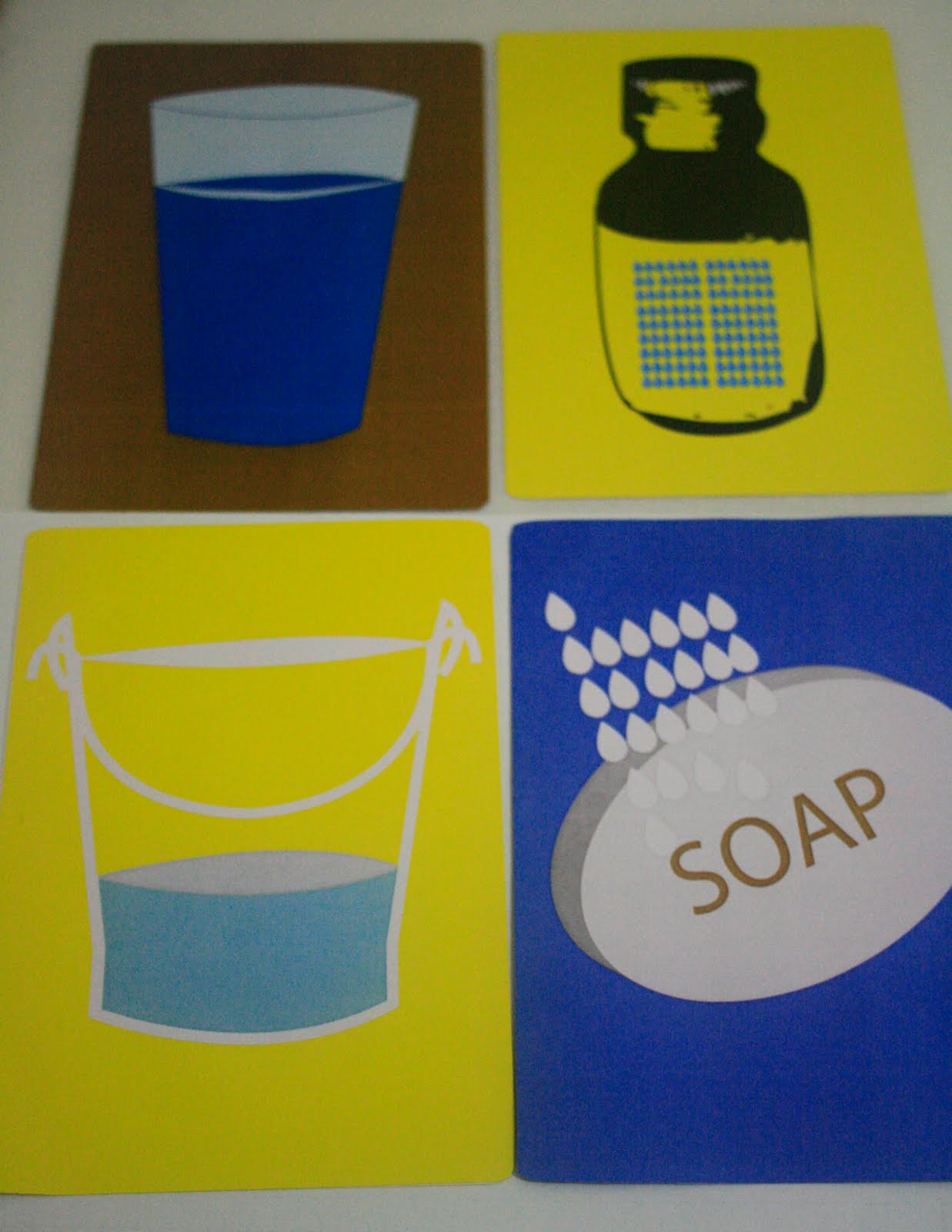
The flash cards that we stuck up in campus
Inference: Through this, I might get to know how much these children know about the water touch-points, how much it actually affects their lives and what they are willing to do about it as well as what they feel is ‘ideal’ and how much we can actually cater to actually fulfilling that. They will also be introduced to basic health and sanitation.
Assumptions:
> Some of these things will be new to them
> Seeing the flash cards and placing them in context might make them change their mind about some of these practices
> They will be curios and ask me questions related to the same.
> They will be able to link these to the practices in their school and homes
Reactions
I began the presentation right after their lunch break. They were excited to see the presentation because of the novelty of the laptop, but already seem to know about what they need to follow in terms of health and hygiene, like many of us do! This was just to trigger off thoughts in their heads and act as a preamble to the artifacts they were going to be introduced to. The flash cards had two sides- the practice on one side and what one might miss, on the other. For example, it is not enough just to wash one’s hands. One needs to do so with soap. So, I asked them how many of them washed their hands just then, before lunch and all of them raised their hands. Then I asked how many of them had washed with soap, and they started laughing and put all their hands down. Similarly they store water collected from the open wells in covered matkas, but do not boil it before drinking. They were almost surprised when I said we must boil our water to remove the germs. Similarly, the do not have washrooms in school. The girls go in a big group behind the greenery to the right side of the school and the boys go out to the road and they do not wash their hands after. The washrooms in school are only for the staff! I told them about the importance of using the washrooms and to take a bucket of water while they go and wash their hands with soap after they are done (to make this easier for them, we made small hand-washing devices with soap strips attached to them so that they could take it out with them wherever they were going to pee). After this was done, we identified places in their school where these practices fit in and stuck the cards there so that each time they see it, they might just follow some of those practices. The staff and the teachers also came with us and saw us stick the flash cards.


Chowdamma sticking the washing hands and soap card on the tank in school where they wash their hands


Putting up the boiling water card outside the school kitchen and the collect rainwater on the class door.
They assured me that they would stick it on the tank when its built in their school next month!
Inference
> Most of them know the facts
> They are more excited about the practical aspect of learning
> They were able to link the practices I was talking about, to the ones they follow in school and at home. They were able to question it. Only things like bathrooms and toilets needs administrative level support, but smaller things like boiling, filtering and washing hands- they can do themselves
> They enjoyed going out on a tour of the school and fighting over who would stick the cards in the appropriate places. It was almost like a treasure hunt. They decided that the one who was able to correctly state what the card talked about and identified the place would be the one to go stick it up.

Subscribe to:
Posts (Atom)